

What Makes a British Watchmaker?

"British watchmaker" sounds like a straightforward description.
But what does it actually mean?
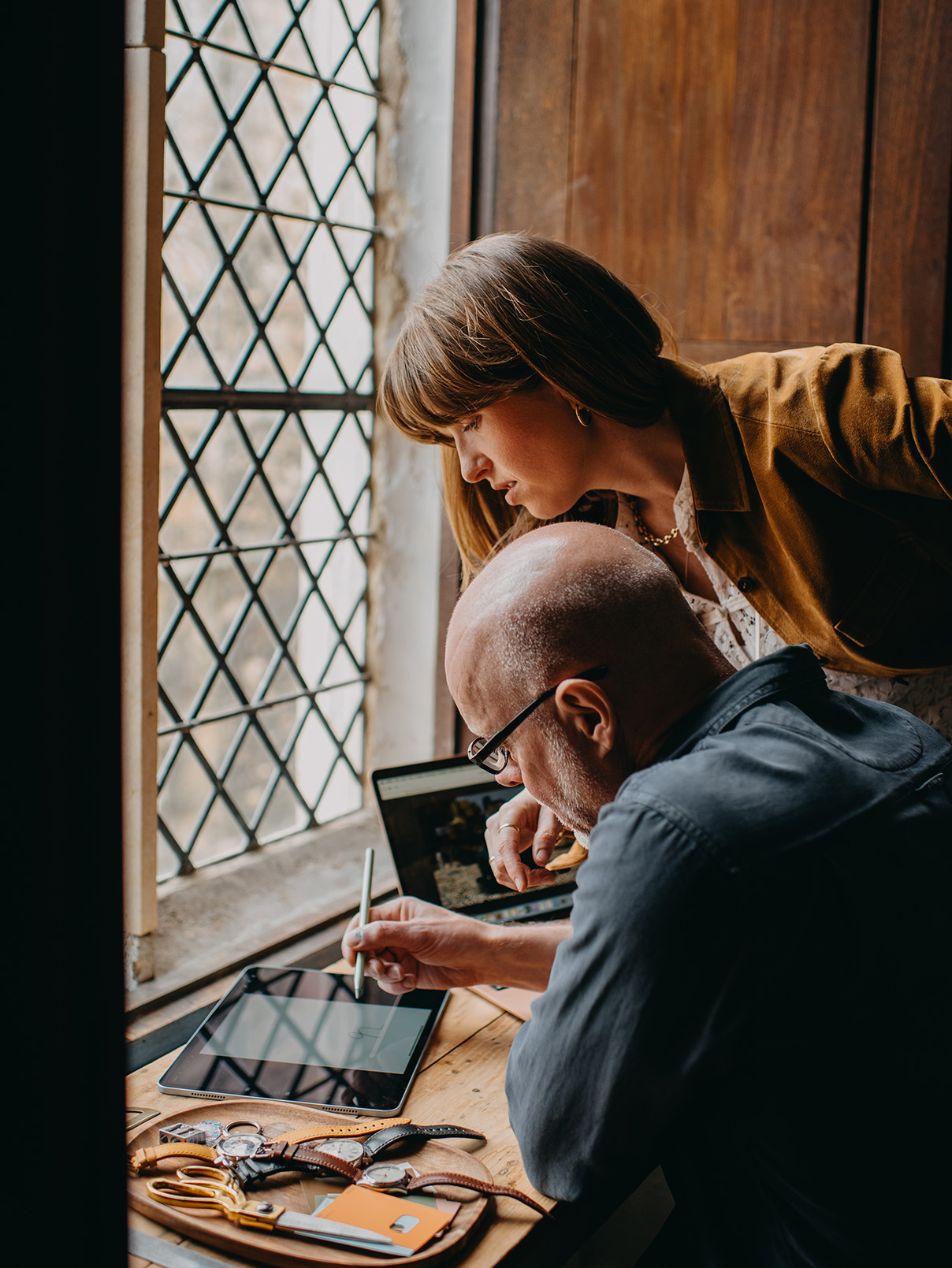
For us, it starts with a workshop.
Not a showroom with a British name above the door. Not simply a watch designed in Britain and made somewhere else.
A real place where watches come together.
Ours is in Lincoln.
It's where Rob assembles every Pinchbeck watch, regulates it, tests it and prepares it before it leaves us.
But that's only part of the story.
It starts with the people
Pinchbeck has always been a small business.
Paul and Jason started the company more than twenty years ago, bringing the Pinchbeck family name back to watchmaking. Jason began designing the watches. Rob joined the business and developed his watchmaking skills at the bench. Emily now looks after the stories, images and community around the watches.
There are four of us.
That's still the shape of the business today.
Being small isn't something we need to dress up.
It means we know the watches we're making.
We know the people making them.
And we know the people who buy them.
British doesn't mean every component is British
This is something we're happy to be clear about.
Our watches use Swiss mechanical movements.
We don't manufacture those movements ourselves.
Our dials are printed by Bedford Dials in Worcestershire, a company we've worked with for around twenty years.
Our leather straps and watch wallets are hand-cut and hand-stitched by Tanner Bates in Devon.
Each brings a specialist skill to the finished watch.
We don't think being a British watchmaker means pretending otherwise.
It means knowing where the parts come from, working with people we trust and being honest about the part we play.
The watch comes together in Lincoln
This is where everything meets.
The movement arrives ready to be worked with.
The dial arrives from Bedford Dials.
The leather arrives from Devon.
The design has already been developed.
Then Rob brings those elements together at the bench.
He assembles the watch.
He fits the dial and hands.
He regulates the movement.
He tests the finished watch.
And he checks it before it leaves.
That's our part of British watchmaking.
The watch comes together here.
Small numbers matter
We don't need to make hundreds of watches at once.
In fact, we don't want to.
Our watches are built to order, so the process starts when someone chooses one.
That keeps the workshop at the centre of the business.
It also means we're able to spend time doing the things that matter to us.
Designing a new dial.
Trying a different colour.
Working on a Watchmaker's Special.
Talking to a customer about a particular watch.
Or simply making the next watch properly.
So, what makes a British watchmaker?
For us, it's not one particular component.
It's not a flag on the dial.
And it's not a claim that everything happens in Britain.
It's the combination of things.
A British business.
A British design team.
A real workshop in Lincoln.
A watchmaker at the bench.
Long-standing relationships with specialist British suppliers.
Swiss mechanical movements.
And a decision to keep making watches in small numbers, one at a time.
That's what being a British watchmaker means to us.
Not something we need to make sound grander than it is.
Just a watch.
Designed here.
Assembled here.
Tested here.
And ready to leave the workshop.


Comments