

Watch Assembly: How We Make a Pinchbeck Watch
It Takes Time to Make a Watch

There is a lot that happens before a Pinchbeck reaches your wrist.
Some of it happens in our workshop in Lincoln.
Some of it happens further afield, with people we've worked with for many years.
And some of it begins with a conversation about a colour, a shape or a detail that we think could make a good watch.
A Pinchbeck doesn't appear fully formed.
It comes together piece by piece.
It starts with the design
Before anything reaches the workbench, there is a design to settle.
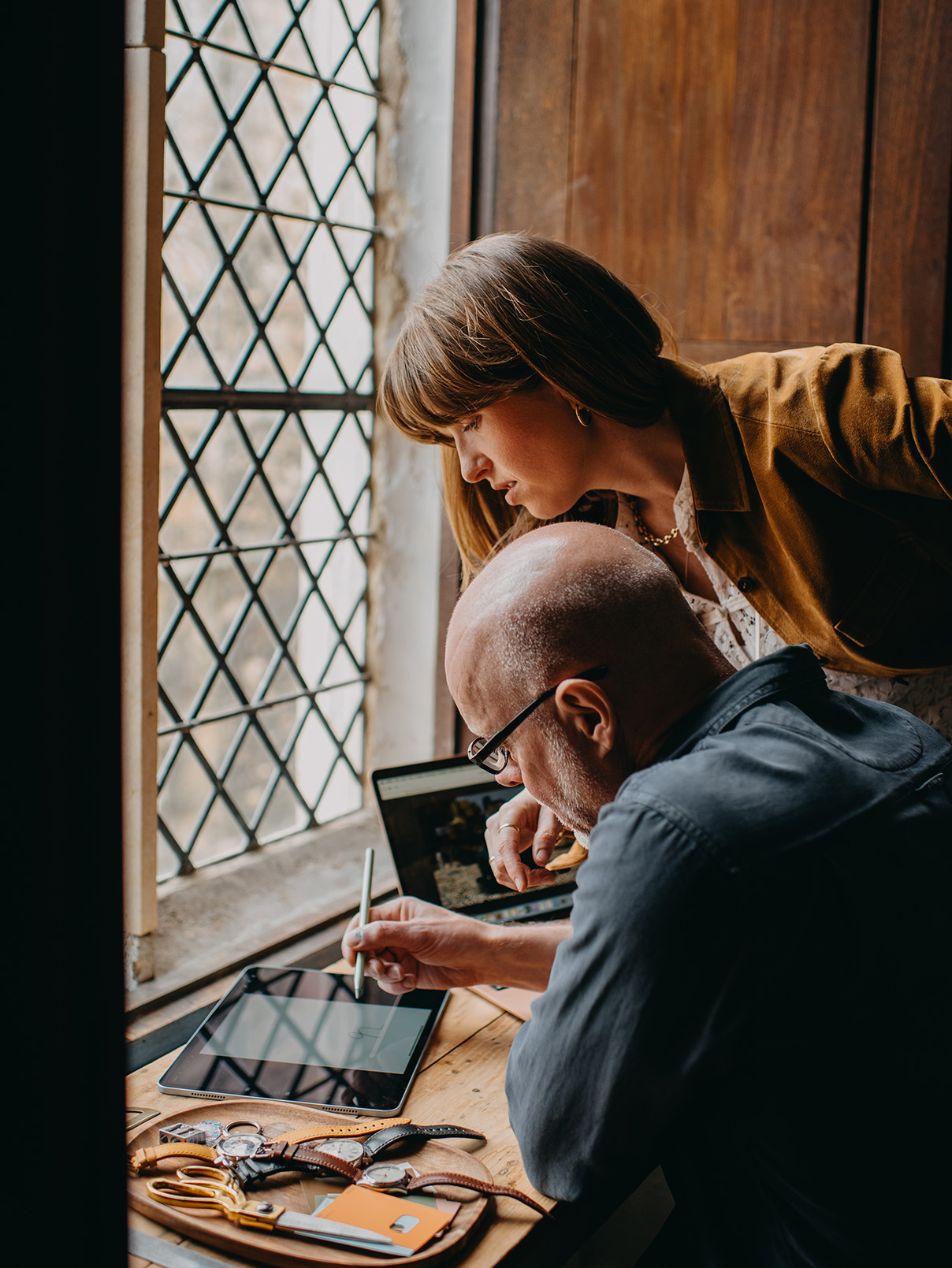
Jason works through the proportions, dial, hands, case and details that give each watch its character. Some decisions are straightforward. Others take much longer.
We like the result to look simple.
Getting there isn't always quite so simple.
Once the design is settled, the different components need to be made.
That's where our long-standing relationships with specialist suppliers become part of the story.
The dial
We've worked with Bedford Dials in Tenbury Wells, Worcestershire, for around twenty years.
They print every Pinchbeck dial for us.
A new dial doesn't simply go from an idea to a production run. We work through what we're trying to achieve, test the printing and make adjustments until the finished dial looks right.
Colour matters.
So does the weight of the printing, the proportions and the way everything sits together.
Once we're happy, the dials are produced and make their way to Lincoln.
It's a relationship that has been part of Pinchbeck almost from the beginning.
The movement
We use Swiss-made mechanical movements from established movement manufacturers.
We don't make the movements ourselves.
We're quite open about that.
The movements arrive already built. Our job begins with bringing them together with the rest of the watch here in Lincoln.
That's an important distinction.
Being a British watchmaker doesn't mean pretending every component comes from one building.
It means being clear about what we do, who we work with and where the watch comes together.
The leather
The strap is another part of the watch that begins somewhere else.
We work with Tanner Bates in Devon, who hand-cut and hand-stitch our leather straps and watch wallets.
The leather is made for our watches, with the colour, stitching and finish chosen to work with each design.
You'll often see details that bring the strap and watch together. A contrasting stitch. A particular shade of leather. A Watchmaker's Special with a matching wallet.
Those details matter.
They are part of the finished watch, not an afterthought.
Then it comes to Lincoln
Eventually, all those pieces arrive at our workshop.
This is where Rob comes in.
Every Pinchbeck watch is assembled by Rob in Lincoln. The movement, dial, hands, case and other components come together at the bench. The watch is regulated, tested and checked before it leaves us.
This is the part of the process people often don't see.
The small adjustments.
The checking.
The testing.
The moments when something needs another look before it is right.
A watch doesn't leave simply because the calendar says it should.
It leaves when we're happy with it.
So why does it take around eight weeks?
Because your watch doesn't exist when you place your order.
Your order enters our workshop schedule, the components are gathered and the watch begins its journey through preparation, assembly, testing, inspection and final finishing. Our usual build time is around eight weeks.
Eight weeks isn't eight weeks of someone working on your watch every minute of every day.
It's the time the whole process takes within a small working workshop.
We're not making watches simply to fill shelves.
We're making the watches that have been ordered.
One at a time.
It takes more than one pair of hands
There's something we like about the fact that a Pinchbeck passes through so many hands before it reaches its owner.
A dial printed in Worcestershire.
A leather strap hand-cut and stitched in Devon.
A Swiss mechanical movement.
Design decisions made here.
And finally, Rob at the bench in Lincoln, bringing everything together.
That's what makes the story interesting to us.
We don't need to pretend we make every component ourselves.
We know who makes them.
We've worked with some of those people for twenty years.
And we know exactly where the finished watch comes together.
In our workshop in Lincoln.
It takes time to make a watch.
And sometimes, it takes quite a few people too.

Comments