

A Watch Starts With More Than a Drawing
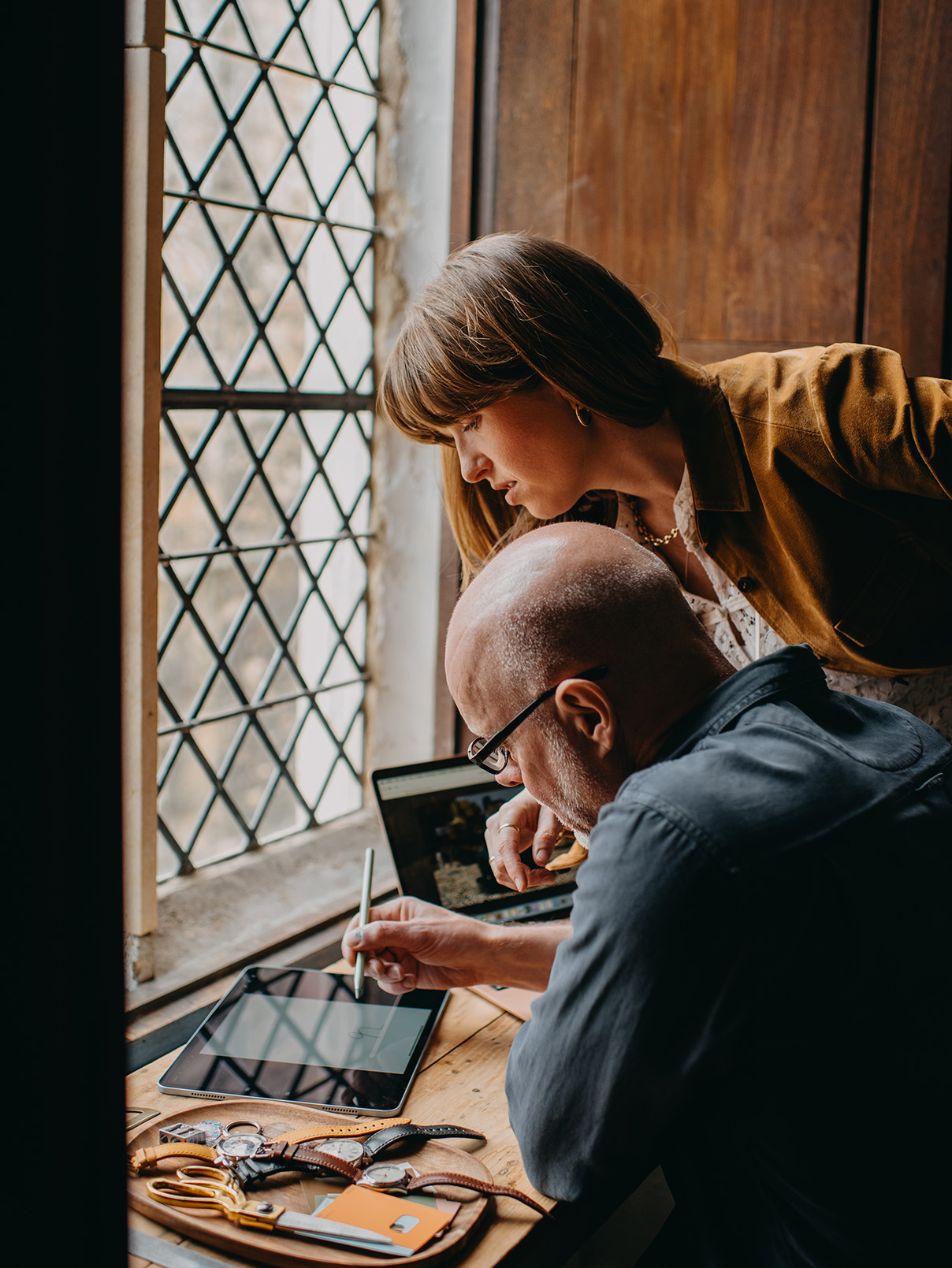

A watch rarely starts with a drawing. Sometimes it starts with a colour. Sometimes a texture, a piece of leather, an old photograph or something Jason has noticed and wants to explore. And sometimes it starts with a conversation that goes nowhere.
Our workshop in Lincoln is small enough that ideas don't stay in one person's corner for very long. Jason might be working on a dial, Paul will have a thought, Rob will look at it from the point of view of actually having to make it. Before long, we're all involved.
That's one of the things we like about working this way. The watch gets talked about.
Not every discussion is easy. Sometimes we can't agree on a direction. Sometimes something looks right on a drawing but doesn't feel right when we start making it. Sometimes the problem is much simpler. We just can't agree on the colour.The new Cathedral watch went through exactly that. The colour changed. Then it changed again. And again.
It is easy to imagine that a watch design arrives fully formed, but that's rarely how it happens. There is a lot of looking, changing, putting things next to each other and asking whether we've got it right. Colour is particularly difficult.
We're currently trying to decide what comes next for the Sigma, and it has become a surprisingly difficult conversation. We know we want something that has presence. Emily keeps coming back to orange because she wants a colour that really pops on the wrist.But which orange?That's the problem. A colour can look fantastic on its own and completely different when it becomes a watch. It has to work with the dial, the case, the hands, the strap and, perhaps most importantly, with the person who is going to wear it.
There's also the less glamorous question of whether people will actually buy it. We can love a colour and still have to ask whether it makes sense as a watch. That's part of the job. We're not designing in isolation. We make watches to be worn. The Albion had a similar conversation. The first idea was light blue. It looked good, but as we lived with it, something didn't feel quite right. It started to take the watch in a more vintage direction than we wanted.
So we changed it.
That's often what design looks like here. Not a straight line from idea to finished watch, but a series of small decisions, conversations and occasional disagreements. And sometimes the biggest problem isn't the design at all.
When the drawing meets the workshop

Our Orphus is a good example. It is one of our best watches, but it became unexpectedly difficult to make when our case supplier changed the case. Rob couldn't make the watch work properly with the new version. That is the point where the romantic idea of watchmaking meets reality. You can have a watch that everyone loves, but if the parts don't work together properly, you have a problem. We haven't forgotten the Orphus. Quite the opposite.We hope to bring it back. Because sometimes a watch is worth fighting for.
That's one of the advantages of having the workshop, the designer and the people making the watches close together. Problems don't disappear into someone else's department. They get put on the table. Rob can say, "This isn't going to work." Jason can say, "But what if we change this?" Paul can have a completely different view. And we talk about it. Sometimes we leave the room having solved something. Sometimes we leave without a clue. Both are part of making things.
More than the dial

There is a lot of art and visual reference around Jason's workspace. Old images, maps, drawings, colours, textures and objects that have caught his attention. Not all of them become a watch. They don't need to. They are part of the thinking. We're interested in things made by hand because they remind us that materials have character. Leather changes with use. A textured surface catches light differently. A piece of artwork can make you think about colour in a way that looking at another watch never would. That matters when you're designing something mechanical. Because a watch isn't only a mechanism. It is something you hold. Something you put on your wrist. Something you look at hundreds of times without necessarily thinking about it. The leather strap is part of that experience too.
You can get a dial exactly right and still change the whole character of the watch with the strap. The colour, texture, stitching and feel all matter. Then Rob has to make it work. That's the bit we never want to lose. A drawing has to become a case. A dial has to become something that can actually be produced. The hands have to work. The movement has to fit. The strap has to sit properly on the wrist. Eventually, somebody has to make the thing with their hands.
The part we don't always talk about

We want to make watches that people keep. Not simply something that looks good when it first arrives, but something with enough character that someone still wants to wear it years later. We sometimes talk about the hope that one of our watches might become a collector's piece. But that's not something we can decide ourselves. You can't announce that a watch is collectible and make it so. All we can do is try to make something worth keeping. That means having conversations about the small things. It means changing a colour because it has gone too far in the wrong direction. It means putting a design aside when we can't make it work properly. It means coming back to an idea later because we still think there is something there. And then, occasionally, it all comes together. The case is right. The dial is right. The colour works. The hands, strap and movement suddenly make sense as one thing.
You put it on the wrist and the discussion stops for a moment.
That's the good bit.
Not because the process was perfect. It wasn't. The Cathedral changed colour repeatedly. The Albion went from light blue to something else. We're still arguing about the right orange for the Sigma. The Orphus is a watch we love but had to stop making because the case changed and Rob couldn't make it work properly. That's the reality of making watches in a small workshop. Ideas don't arrive finished. They get talked about, challenged, changed, made, taken apart and sometimes brought back to life. And somewhere in amongst all of that, a watch starts to emerge. Not from one drawing.
From all of us.

Comments